Research Report: Multifamily’s Moment or a Long-Term Tailwind: What’s Driving Investor Interest Now
Private real estate fundraising has slowed. Amid persistent inflation, geopolitical uncertainty and the high cost of capital, investors are taking a more cautious stance. The PERE Global Investor 100 ranking shows the aggregate real‑estate exposure of the world’s largest private real‑estate investors declined for the first time ever in 2025.1
Yet in the midst of this pullback, one real estate sector continues to draw attention: multifamily housing. Why? Because despite the macro noise, the fundamentals remain intact and in many markets, they’re strengthening. A structural imbalance between supply and demand, widening affordability gaps and shifting lifestyle preferences are sustaining demand for quality rental product, and creating long-term opportunity for disciplined investors.
In a market where investors are picky and capital is scarce, the quiet resilience of multifamily real estate is standing out. In CBRE’s 2025 Global Investor Intentions Survey,2 multifamily was ranked among the most preferred property types across the US, Europe and Asia-Pacific, where multifamily is still at a nascent stage of development.

While multifamily is drawing interest across the globe, the case in the US is particularly compelling. There, a unique confluence of demographic momentum, structural supply gaps, affordability pressures and regional migration trends is creating an environment where market fundamentals are not only resilient but poised to outperform.
Why Now?
The rent vs. buy gap is widening
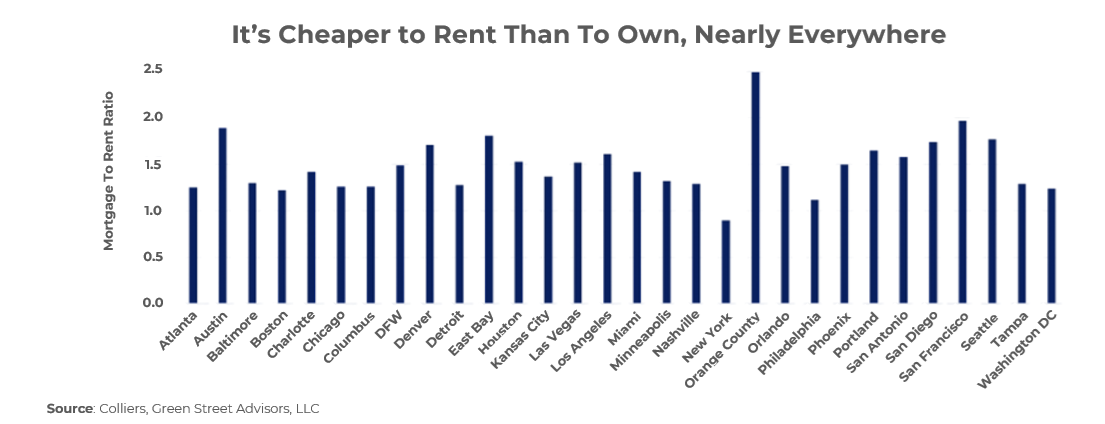
For most US households, owning a home remains out of reach. According to a recent Colliers-Green Street analysis, renting is now cheaper than buying in nearly every US metropolitan area, with the mortgage-to-rent ratio well above 2.0x in markets like Orange County, CA.3 Occupancy rates also remain high, with most major markets reporting levels over 90%, highlighting the continued tightness in rental housing supply.
Demand is here to stay
US renter household growth was up by 848,000 in 2024 and continued into early 2025, pushing the renter share of households to nearly 35%, or 46.1 million households, according to The Harvard Joint Center for Housing Studies.4 That’s close to the peaks seen in the 2010s. To compare, renter household growth averaged just 171,000 per year from 2019 to 2022.
At the same time, the number of homeowner households in the US fell 0.1% year over year to 86.2 million in Q2 2025 – a small dip but notably the first since 2016, according to Redfin.5
This isn’t just about economic pressure. While high mortgage rates and rising home prices have pushed many out of the ownership market, the appeal of renting also reflects a growing demand for flexibility and lifestyle choice. For example, professionals prioritizing flexibility, people getting married later in life, and downsizing boomers seeking low-maintenance living are increasingly choosing to rent. These dynamics point to a structural shift supporting sustainable long-term demand for high-quality, flexible living options.
Locked-in homeowners
The lock-in effect remains powerful. With millions of owners sitting on lower mortgage rates, resale activity is limited. A Redfin analysis6 found 80% of US mortgage holders have an interest rate below 6% and just over half are on a rate below 4%. That’s a powerful disincentive to sell, especially in a market where new mortgage rates are hovering around 6% and in metros where the rent vs. buy gap remains wide.

Supply Slowdown
Multifamily starts across the US have dropped significantly: 2024 saw 337,000 new starts, down roughly 36% from their 2022 peak, according to Colliers research.7 As current projects complete and fewer new developments break ground, undersupply is expected to prop up demand and rent growth in some regions. For example, Midwest areas like Kansas City, Chicago and Detroit, which have seen less recent development, rank top in the country for rent growth.
Migration Momentum
Broader migration patterns continue to benefit secondary and tertiary markets across the Mountain West, Pacific Northwest, Southeast, and parts of Texas. Aside from relative affordability, key draws include quality of life and economic expansion. This underscores the need for localized strategies that align with each market’s evolving fundamentals, tenant base and pricing power.
By contrast, several Sunbelt metros such as Austin, Phoenix, San Antonio and Atlanta, have seen elevated construction activity in recent years, leading to a lag in rent growth. However, these high-growth markets are also supported by favorable long-term demographic trends and rebalancing fundamentals are restoring their long-term investment appeal.
What differentiates in this market?
- Operational edge matters more than ever
Multifamily is an operating business at its core. As the tide of cap rate compression recedes, performance will rest more heavily on execution. That involves controlling expenses, driving tenant satisfaction and increasing net operating income (NOI). GPs who focus on operational fundamentals can create outsized value without relying solely on capital intensive improvements or external forces.
- Local Advantage
Real estate has always been local, but in this environment, it’s hyper-local. Success comes down to knowing the block, not just the zip code. GPs with vertically integrated platforms and a boots-on-the-ground presence in target markets have a sourcing, execution and operations edge, particularly in cities where fundamentals are still rebalancing post-supply surges. Understanding tenant demographics, regional employment drivers, and local policy environments is essential for long-term outperformance.
- Rethinking Value
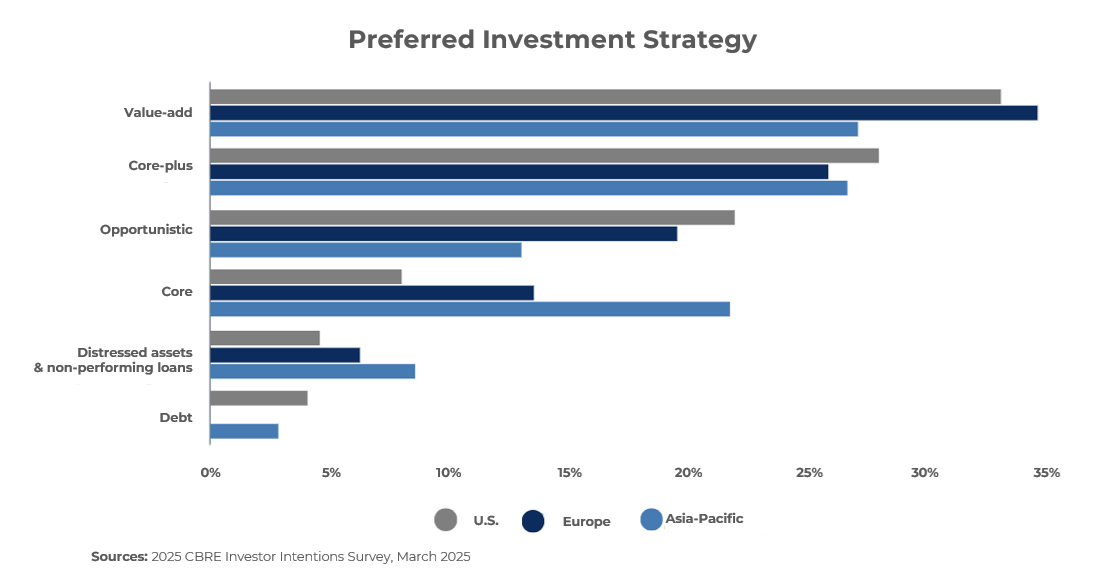
Investor appetite has clearly swung toward strategies that offer a path to enhanced returns through asset-level business plans. According to the 2025 CBRE Investor Intentions Survey, value-add strategies were the top choice for investors globally,8 with core-plus close behind. Together, they were the preferred strategies for nearly two‑thirds of investors across the globe.9 These strategies align well with today’s environment: investors want to see tangible execution upside, not just yield compression or market beta.
Not all value-add strategies are created equal. With debt still expensive and capital more selective, many managers are moving away from heavy renovation plays. Instead, they are leaning into operationally-driven improvements, including targeted refreshes, lease-up strategies or tech-enabled efficiencies. The focus has shifted from deep CapEx to smart asset selection and thoughtful NOI enhancement.
CBRE expects US multifamily rents to grow by 3.1% annually through 2029, outperforming the pre-pandemic average of 2.7%.10 While macro risks remain, the fundamentals behind multifamily are hard to ignore. Multifamily isn’t a trade. It’s a long-term need.
In a capital-constrained market, durable demand, local knowledge and operational expertise matter more than ever. The best GPs aren’t just weathering the current cycle. They’re leaning into it with discipline, strategy and a strong view on the profile of tomorrow’s renters and where and how they want to live. For investors seeking inflation protection, stable yield and demographic tailwinds, multifamily stands out as a compelling and enduring strategy.
1 https://www.perenews.com/the-gi-100-grapples-with-shrinking-allocations-to-real-estate/
2 https://www.cbre.com/insights/viewpoints/2025-global-investor-intentions-survey
3 https://www.colliers.com/en/research/nrep-uscm-usmf-colliers-capital-markets-multifamily-report-2025
4 https://www.nahro.org/article/harvard-joint-center-for-housing-releases-the-state-of-the-nations-housing-2025-annual-report/
5 https://www.redfin.com/news/homeownership-rentership-rate-q2-2025/
6 https://www.redfin.com/news/rate-lock-q2-2025/
7 https://knowledge-leader.colliers.com/aaron-jodka/quick-hits-the-composition-of-housing-starts-is-changing/
8 https://www.cbre.com/insights/viewpoints/2025-global-investor-intentions-survey
9 https://www.cbre.com/insights/briefs/2025-us-investor-intentions-survey
10 https://www.cbre.com/insights/books/us-real-estate-market-outlook-2025/multifamily